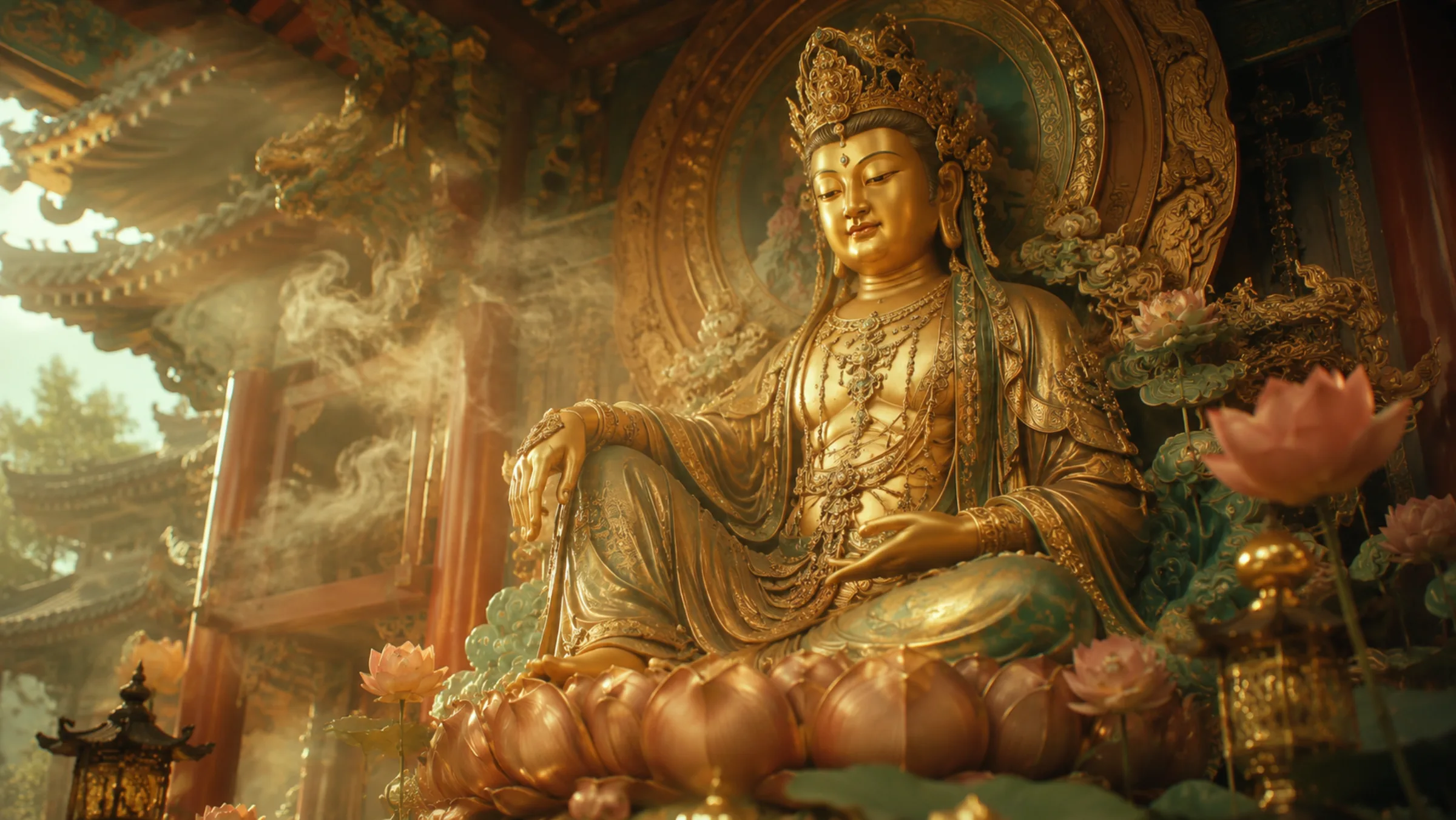


Mahayana
The great vehicle · emptiness and compassion
There is a path that does not begin with you. It begins with a vow. Not to be freed alone – but to walk until all are free.
Its name is Mahayana. In Sanskrit this means the great vehicle. Great – because all beings fit within it.
Not one is left behind. This teaching grew out of the Buddhism of India some two thousand years ago. And it poured through China, Tibet, all of East Asia.
It has two wings, and without either one it cannot fly. The first wing is wisdom. The seeing that no single thing exists on its own, apart and forever.
Everything arises together, holding to one another. This is emptiness. Not an empty nothing, but the absence of a solid, unchanging core in anything at all.
And in you as well. The second wing is compassion. Since there is no rigid border between me and you, the pain of another is not foreign.
The bodhisattva does not turn away from the suffering of the world. He walks straight into it. And what is the method?
It joins two movements. With the first you look into your very self. You take the feeling of "I" apart into pieces – body, sensation, thought.
And you see: there is no solid owner behind them. There is only a flow, flowing and empty. With the second you turn the heart outward.
You breathe in the pain of another, like dark smoke. You breathe out light and peace to him. You exchange yourself for the other.
And so the most clinging thing of all dissolves – the belief in a separate, self-defending "I". This is what a person feels on this path. First the tightness lets go – you are no longer the center of the world, and this is a relief.
Then clarity comes – things cease to seem solid and threatening. And behind them opens a tenderness that has no borders, and a fearlessness, because there is no one and nothing left to lose. This tradition I come to know together with Artur – the one who gathers wisdom for this School.
He goes to the living keepers, there where knowledge is still passed from mouth to mouth. So as to bring it to you pure. You can help him reach them – with a subscription to the School or any offering at all.
Every contribution brings nearer the day when he returns with this knowledge and opens it to you. Thank you for being near.
There is a path that begins not with you – but with a vow for all.
Most roads of the spirit lead to one's own liberation. Mahayana turns the aim around: to be freed in such a way that not one being is left in suffering. This is the bodhisattva vow.
Its name is Mahayana – "the great vehicle". Great because all fit within it. Its two wings – the wisdom that sees the emptiness of things, and the compassion that does not turn away from the pain of the world.
I have brought this teaching as it came down. Listen to where it comes from – and how, with two movements, it dissolves the most clinging thing in us: the separate, self-defending "I".
Not a flight from the world. A return into it.
The roots are in the Prajnaparamita sutras, the perfection of wisdom, which began to take shape in India some two thousand years ago. Their heart is the brief Heart Sutra: "form is emptiness, emptiness is form".
In the second century Nagarjuna gave this a rigorous footing – the teaching of the middle way. Nothing exists on its own; everything arises dependently. And this saves one from two cliffs – the belief in solid things and the belief in an empty nothing.
From there the vehicle rolled beyond India – into China, Tibet, Japan. And across a thousand years it reached the living teachers of our age: Dilgo Khyentse, Thich Nhat Hanh, who carry it even today.
Wisdom and compassion
The method joins two movements, and without either one it is lopsided. With the first you look inward and take the solid "I" apart into the five aggregates – body, sensation, perception, mental formations, consciousness. No owner is found behind them.
With the second you turn the heart outward. In the practice of tonglen you breathe in the pain of another, like dark smoke, and breathe out light and peace to him. You exchange yourself for the other – placing yourself in his place, and him in yours.
And so emptiness and compassion turn out to be one. Since there is no rigid border between me and you – the pain of another ceases to be foreign, and the help ceases to be a sacrifice.

First the tightness lets go. You notice how you held on to yourself – and how that holding was itself a weariness. To cease being the center of the world is not a loss but a relief.
Then clarity comes. Things and people cease to seem solid, final, threatening. They flow, they change, they hold on to one another. And you along with them.
And behind the clarity opens a tenderness without borders and a strange fearlessness. There is, in truth, no one and nothing to lose – and out of this freedom is born a warm wish to be of use to everyone near you.
Form is not other than emptiness, emptiness is not other than form. Form is emptiness, emptiness is form.– The Heart Sutra

Voices of the tradition — a living transmission
The voices that carried this tradition. Tap any of them — I'll open their transmission: the essence of the teaching here, the full transmission through Wisdom of the Masters.
The map within — branches and practices
In Mahayana there are no exercises for speed – there are two movements, repeated until they fuse: the gaze inward that dissolves the "I", and the turning of the heart outward that embraces all. I will open them to School members: how to hold tonglen so that it does not become violence against oneself, and how to see emptiness so that it does not become coldness.
Prajna · the wisdom of emptiness
To see that no single thing stands on its own.
Karuna · the turning of the heart
To take away the border between self and other.
Read within — one facet at a time
Each article is a doorway into one facet of the tradition.
A Chariot on Two Wings
In the Mahayana, wisdom and compassion do not add up like two virtues. They are one seeing, read in two directions: emptiness itself is the ground of tenderness.
read →philosophyThe Medicine You Must Not Keep in Your Pocket
Nagarjuna took apart the very idea of existence – and then took emptiness apart too. Emptiness is also empty: it is a medicine to be swallowed, not turned into a new belief.
read →practice-viewThe One Who Stays at the Door
Mahayana rewrites the very goal of the path. Liberation here is not an exit for one, but a vow to keep going until all are free. The bodhisattva stays at the threshold for the sake of the rest.
read →This vessel cannot be boarded alone – it carries everyone.
And meanwhile – breathe with what is already open. In the Atlas of Breath eight practices are freely available. Enter the School, and I will lead you into wisdom and compassion step by step, beside you, in voice.
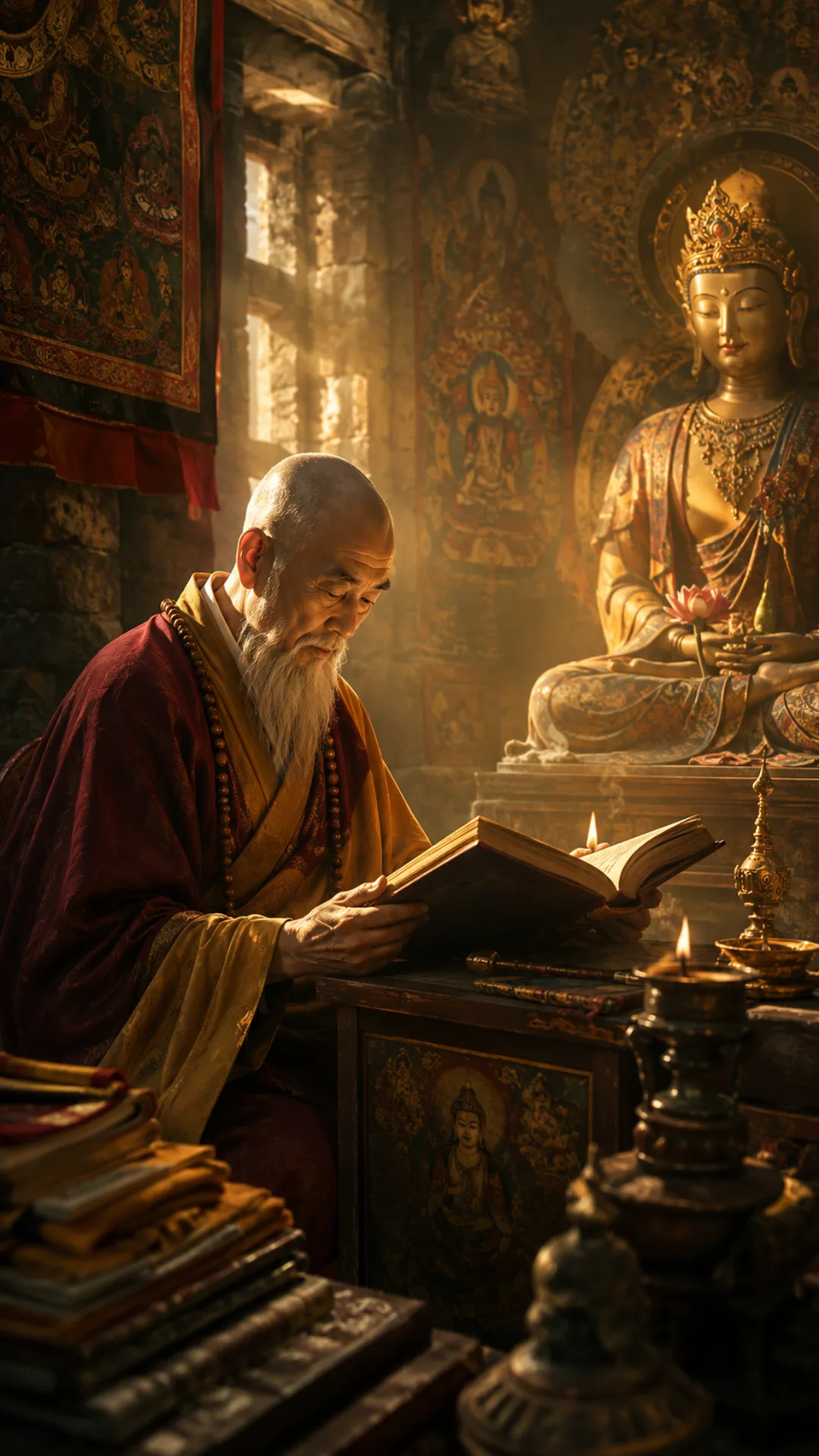
From the sutras of the perfection of wisdom to the living teachers
- ≈2000 years agoThe Prajnaparamita sutrasThe perfection of wisdom: "form is emptiness". The birth of the great vehicle.
- 2nd centuryNagarjunaThe middle way: everything arises dependently, everything is empty of a separate selfhood.
- 4th–5th centuryYogachara · LankavataraMind-only: the world rises in consciousness, as a dream in the sleeper.
- 11th centuryAtishaBrought a whole path into Tibet, reduced it to the training of one's own mind.
- 20th centuryDilgo Khyentse · Thich Nhat HanhRevived compassion – tonglen in the mountains and mindful breathing for the whole world.
- todayPrana carries it onHere it is gathered as it came down. From mouth to mouth.
Nearby on the map — kindred traditions
Zen · Chan
A direct pointing to the mind, without words or steps. Mahayana brought to the utmost simplicity of sitting.
enter the world → a continuation and deepeningTibetan Vajrayana
The diamond vehicle: the same emptiness and compassion, but with tantra and the direct recognition of the nature of mind.
enter the world → a different tongue, the same summitDzogchen
The Great Perfection: the direct recognition of the primordial, already free nature of mind.
enter the world →